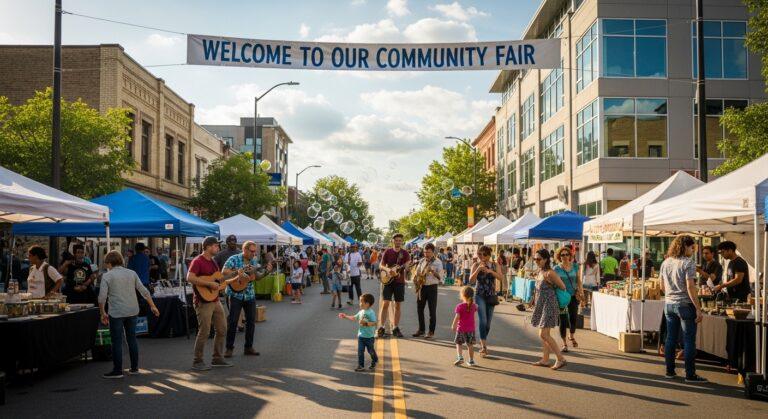
A diverse Brazilian community gathering at a street festival with music, food stalls, and colorful decorations.
Updated: March 16, 2026
Across Brazil’s cities and towns, the everyday exchange of neighborly help, culture, and collective problem-solving is quietly rewriting what ‘community’ means. In public discourse, the motif that emerges is one where social ties extend beyond family or church: a fabric that, in many places, truly feels Community Brazil.
Community Mosaic
Brazil’s community life is not monolithic. It spans from the iconic samba clubs in dense urban cores to rural collectives around shared water sources, from church groups and capoeira circles to school parent associations. In many neighborhoods, local networks organize around markets, bus routes, and school events, turning everyday friction into opportunities for collective action. The resilience of these networks lies not just in philanthropy or charity, but in routines: a volunteer watch at the corner store, a group chat coordinating carpools, a neighborhood association maintaining public spaces. This mosaic challenges stereotypes that communities are defined only by poverty or conflict; it shows them as vibrant systems of mutual aid and cultural exchange that adapt to changing needs and generations.
Challenges and Opportunities
National statistics often highlight inequalities, but the real story emerges in the margins where networks compensate for gaps in formal service delivery. In many cities, local leaders and volunteers face bureaucratic hurdles, funding uncertainty, and safety concerns that blunt ambitious projects. Yet the same friction can catalyze innovation: community-led savings groups, street-level health campaigns, and cultural festivals that anchor civic identity. As digital access expands, online neighborhood groups become extension of street-level organizing, enabling broader participation while also demanding more inclusive practices to avoid echo chambers. The causal link between social cohesion and policy outcomes—better public health, more effective policing, and stronger disaster response—becomes clearer when observers track concrete events: a mutual aid drive during a flood, or a neighborhood committee coordinating vaccination clinics with city health workers.
Policy Levers and Local Leadership
Leaders at the municipal and state levels increasingly recognize that lasting change depends on strengthening local ecosystems of participation. Public funding for community centers, arts programs, and after-school initiatives can be designed to reward collaboration rather than competition. Participatory budgeting, where residents directly decide how a portion of city funds is spent, has deep roots in Brazil and offers a model for scaling effective neighborhood projects. But implementation requires guardrails: transparent processes, accountability measures, and inclusive outreach that brings women, youths, and marginalized groups to the table. Beyond money, leadership means enabling spaces where residents can experiment—pilot projects in sanitation, mobility, and digital literacy that, if successful, can be scaled with municipal buy-in. The diaspora also matters: connections back to family and former neighbors can mobilize resources and knowledge, reinforcing a windward path from community practice to policy design.
Actionable Takeaways
- Residents: organize with your neighbors to map existing assets (schools, parks, markets) and identify gaps in services or safety; build a simple, shared calendar of community events.
- Local governments: fund and co-produce community centers that offer multilingual services, technology access, and after-school programs; publish open data on program outcomes.
- Nonprofits and funders: prioritize long-term investments in capacity building, leadership development for youth and women, and peer-to-peer mentoring networks.
- Media and educators: highlight positive local initiatives and document lessons learned from failed efforts to improve trust and participation.
- Businesses and volunteers: support mutual-aid networks with in-kind contributions, pro bono services, and skills-based volunteering that matches community needs.
- Researchers and policymakers: track social outcomes with simple metrics—participation rates, service reach, and outcome improvements—to inform scaling decisions.
Source Context
For readers seeking broader perspectives that illuminate the themes in this report, the following sources offer related angles on community life, mutual aid, and leadership in Brazil and beyond:
- It feels like home: Samba Brazilian Kitchen brings Carnaval to Gainesville — The Independent Florida Alligator
- Reviving Joe Brazil’s vision for jazz, mutual aid and collective joy — KNKX
- Barbara Sherman obituary — Tigard Life
From an editorial perspective, separate confirmed facts from early speculation and revisit assumptions as new verified information appears.
Track official statements, compare independent outlets, and focus on what is confirmed versus what remains under investigation.
For practical decisions, evaluate near-term risk, likely scenarios, and timing before reacting to fast-moving headlines.